

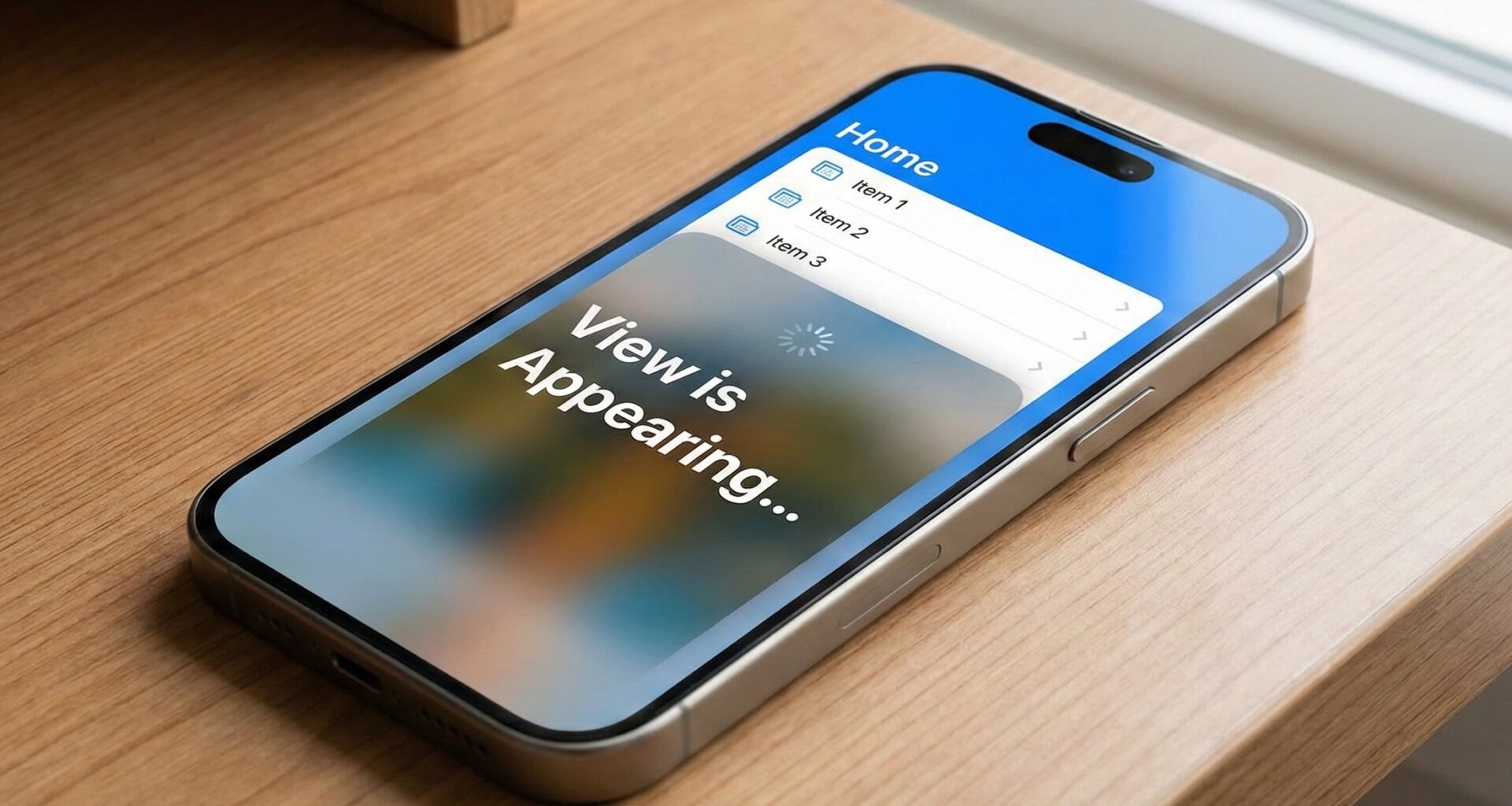

In Swift programming, the transition from UIKit to SwiftUI changed the rules of the game. We no longer have viewDidLoad or viewWillAppear in the same way; instead, we rely on modifiers that react to state changes and view presentation on the screen.
We are going to dive deep into one of the most common debates when working in Xcode: .task() vs .onAppear() in SwiftUI. We will explore their differences, similarities, and when to use each one to optimize your apps in iOS, macOS, and watchOS using Swift.
Introduction to the View Lifecycle in SwiftUI
In SwiftUI, views are lightweight and ephemeral structures. They are not objects that persist in memory the same way UIView instances do in UIKit. They are constantly recreated when the state (@State, @Binding, @Environment, etc.) changes.
However, we often need to execute code exactly when a view is first shown to the user, or when it disappears. This is where lifecycle modifiers come into play.
Below, we will break down exactly how .onAppear() and .task() work, and why the arrival of modern concurrency in Swift has changed our best practices.
Deep Dive into .onAppear()
The .onAppear() modifier has been with us since the birth of SwiftUI in iOS 13. Its main function is to execute a synchronous block of code just before the view is added to the view hierarchy and appears on the screen.
Key Features:
- Synchronous by default: The closure (code block) you pass to
.onAppear()is synchronous. - Lack of automatic cancellation: If you start a long-running process here, it will continue executing even if the user navigates back and the view disappears.
- Compatibility: It works across all versions of SwiftUI (iOS 13+, macOS 10.15+, watchOS 6+).
How is it used?
Imagine you are developing an app in Xcode and you want to log an event in your analytics every time a user opens the profile view:
import SwiftUI

struct ProfileView: View {
    var body: some View {
        VStack {
            Text("User Profile")
        }
        .onAppear {
            // This executes synchronously
            AnalyticsManager.shared.logEvent("Profile_Viewed")
        }
    }
}
The Problem with Asynchronous Work in .onAppear()
As an iOS Developer, your day-to-day involves making network calls, loading images, or reading from databases. If you want to do this in .onAppear(), you will be forced to wrap your code in a Task block (since Swift 5.5) or use Grand Central Dispatch (DispatchQueue.main.async).
.onAppear {
    Task {
        await viewModel.fetchUserData()
    }
}
The big problem here is resource leakage. If the user enters ProfileView and almost immediately taps the “Back” button, the view disappears (triggering .onDisappear()), but the Task you created inside .onAppear is not cancelled. It will keep consuming bandwidth, CPU, and memory. To fix this with .onAppear, you would have to store a reference to the task and manually cancel it in .onDisappear, which requires a lot of boilerplate code.
Deep Dive into .task()
To solve these concurrency and resource management issues, Apple introduced .task() in iOS 15, macOS 12, and watchOS 8. This modifier is built natively to take advantage of the async/await concurrency system in Swift.
Key Features:
- Native asynchrony: The closure provided to
.task()is an asynchronous context (@Sendable async). You don’t need to wrap your code in aTask { }block. - Automatic Cancellation (Pure magic!): This is the biggest advantage. The task created by the
.task()modifier is tied to the view’s lifecycle. If the view disappears before the task finishes, SwiftUI automatically cancels the task. - State management with .task(id:): You can pass it a value that conforms to the
Equatableprotocol. If that value changes, SwiftUI will cancel the ongoing task and start a new one.
How is it used?
Let’s look at the same data loading example, but using the modern approach for Swift programming:
import SwiftUI

struct ProfileView: View {
    @StateObject private var viewModel = ProfileViewModel()

    var body: some View {
        VStack {
            if viewModel.isLoading {
                ProgressView("Loading profile...")
            } else {
                Text(viewModel.userName)
            }
        }
        .task {
            // The context is already asynchronous, no need for 'Task {}'
            // If the view disappears, this call is automatically cancelled.
            await viewModel.fetchUserData()
        }
    }
}
Important note: For automatic cancellation to be effective, the asynchronous code you are calling (
fetchUserDatain this case) must support Swift’s cooperative cancellation. That means it should checkTask.isCancelledor use native APIs likeURLSessionthat already handle cancellation internally.
Comparison Table: .task() vs .onAppear() in SwiftUI
To better visualize the differences at a glance, here is a handy comparison table for any iOS Developer:
| Feature / Modifier | .onAppear() |
.task() |
|---|---|---|
| Execution Context | Synchronous by default | Asynchronous by default (async) |
| Concurrency Integration | Requires creating a manual Task {} |
Native async/await support |
| Automatic Cancellation | ❌ No. The task stays alive if the view disappears | ✅ Yes. Cancelled implicitly when .onDisappear is invoked |
| Automatic Restart | No native state-based mechanism | ✅ Yes, using the .task(id: value) variant |
| Cross-Platform Support | iOS 13+, macOS 10.15+, watchOS 6+ | iOS 15+, macOS 12+, watchOS 8+ |
| Ideal Use Case | UI setup, synchronous analytics | Network calls, data fetching, async subscriptions |
Cross-Platform Development in Xcode
One of the great wonders of SwiftUI is its “learn once, apply anywhere” philosophy. The behavior of .task() and .onAppear() is surprisingly consistent whether you are coding for the iPhone, the Mac, or the Apple Watch.
- On iOS: Both modifiers react to navigation in a
NavigationStackor when a modalsheetis presented. - On macOS: They behave similarly when opening or closing windows, or switching tabs in a
TabView. - On watchOS: Crucial for battery optimization. Given the Apple Watch’s limited resources, using
.task()ensures that if the user lowers their wrist and the view goes to sleep/disappears, heavy network requests are instantly cancelled, saving valuable energy.
The Hidden Superpower: .task(id:)
We’ve talked about how .task() efficiently replaces .onAppear() for asynchronous work. But .task() has a variant that .onAppear() simply cannot match without writing a lot of complex logic: the ability to react to state changes.
Imagine a search application. You want every time the user changes the search term in a bar, the previous search gets cancelled (to not waste data) and a new one begins.
import SwiftUI

struct SearchView: View {
    @State private var searchQuery: String = ""
    @State private var results: [String] = []

    var body: some View {
        NavigationStack {
            List(results, id: \.self) { result in
                Text(result)
            }
            .searchable(text: $searchQuery)
            // Here is where the magic happens:
            .task(id: searchQuery) {
                // We add a tiny pause to "debounce" (avoid overloading the server)
                try? await Task.sleep(nanoseconds: 500_000_000)

                // If the task wasn't cancelled by a new 'searchQuery' change
                guard !Task.isCancelled else { return }

                // Perform the search
                results = await performSearch(query: searchQuery)
            }
        }
    }

    func performSearch(query: String) async -> [String] {
        // Simulated network logic
        return ["Result for \(query)"]
    }
}
In this Swift programming example, if the user quickly types “S”, “w”, “i”, “f”, “t”, the value of searchQuery changes rapidly. The .task(id: searchQuery) modifier detects this change, cancels the previous ongoing asynchronous task, and launches a new one for the latest state. Achieving this level of concurrency control with .onAppear() would require combining Combine or managing Task references by hand.
Best Practices: Which one should I choose?
As a general rule in modern development with Xcode:
- Use
.task()almost always when you need to interact with external or asynchronous data. It is safer, prevents memory leaks, optimizes the network, and requires fewer lines of code. - Reserve
.onAppear()for lightweight and strictly synchronous UI configurations. Things like applying abecomeFirstResponder(in UIKit integrations), sending an isolated analytics event, or initializing simple synchronous state variables.
Conclusion
The transition of .task() vs .onAppear() in SwiftUI is not just a syntactic change, but a paradigm shift towards safer code against concurrency errors. Apple is strongly pushing the use of async/await in Swift programming, and .task() is the perfect bridge between the declarative UI of SwiftUI and structured concurrency.
If you have any questions about this article, please contact me and I will be happy to help you  . You can contact me on my X profile or on my Instagram profile.