

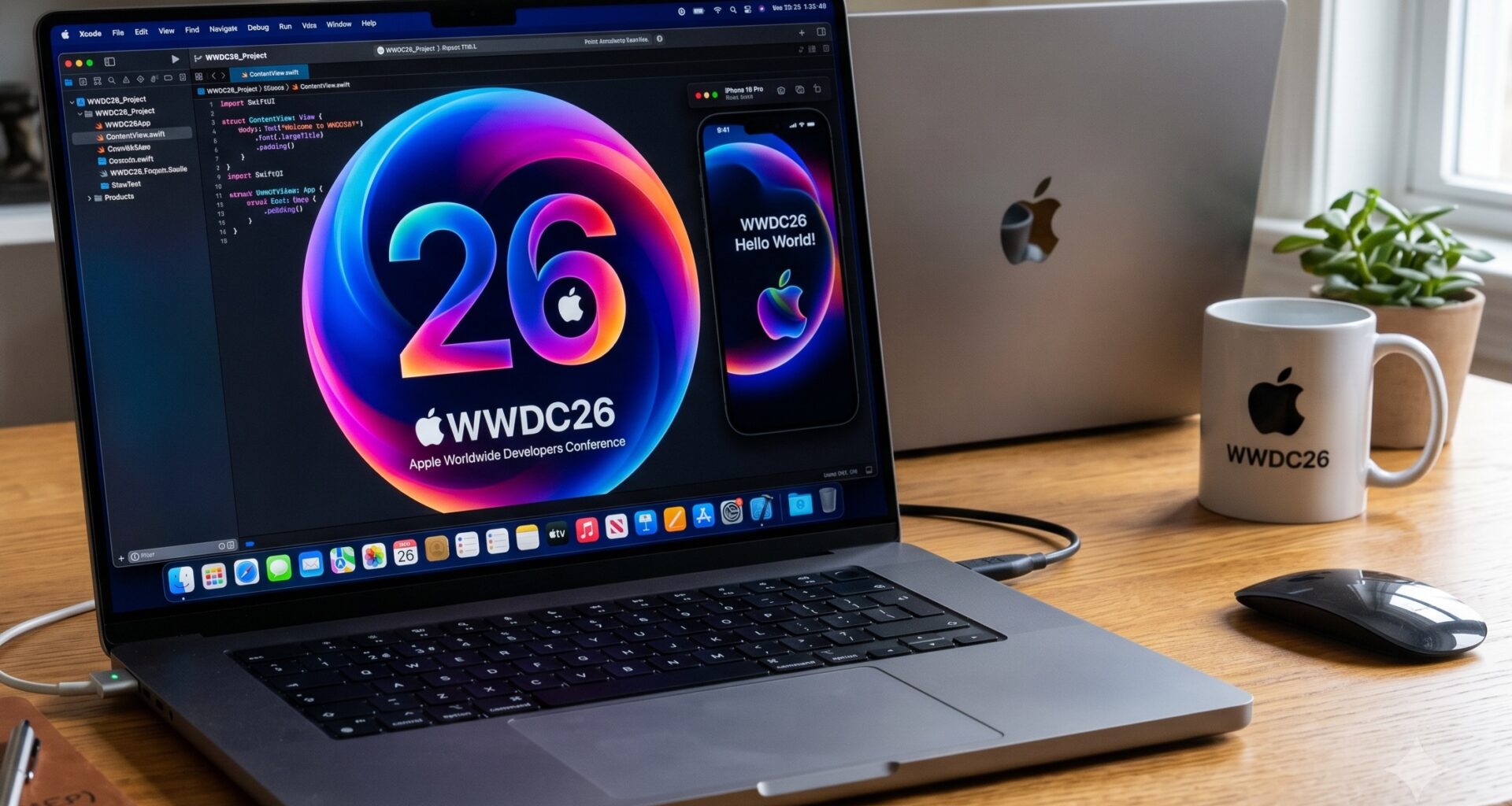

The Apple Worldwide Developers Conference (WWDC) of this year, 2026, will go down in history as the exact moment when software creation took an irreversible quantum leap. On an opening day loaded with astonishing announcements about iOS 27 and the new macOS Golden Gate, the Platforms State of the Union event made it clear that the true protagonist of this year is not the hardware, but the tools. Apple has unveiled a massive restructuring of its integrated development environment, introducing Xcode 27 alongside an unprecedented expansion of its Artificial Intelligence ecosystem through the revamped Foundation Models Framework. These new features are not simple incremental updates; they represent a total reinvention of how software engineers design, write, test, and distribute applications across Apple’s vast ecosystem of devices.
During the presentation, Craig Federighi, Apple’s Senior Vice President of Software Engineering, boldly stated that Xcode is now “the best place” to build applications using agentic programming. This statement is not a mere marketing slogan. The implications of introducing artificial intelligence agents directly into the developer’s workflow completely change the economics of time and effort. From the integration of industry-leading models like Anthropic, Google, and OpenAI, to the democratization of access to free cloud infrastructures for small developers, Apple has built a bridge to the future of code. Below, we will thoroughly break down each of the elements of this colossal update and analyze how it will impact the daily lives of millions of programmers worldwide.
The Structural Rebirth: A Faster, Lighter, and Exclusive Xcode 27
The first major impact of the day came with the underlying architecture of the new tool. Xcode 27 marks a radical turning point: it is the first version that exclusively requires Apple Silicon processors. By definitively abandoning legacy support for the Intel architecture, Apple engineers have managed to optimize the codebase in extraordinary ways. The result is an application that takes up 30 percent less hard drive space, an immense relief for developers who for years have struggled against the massive size of Xcode downloads and updates.
But the size reduction is just the beginning. The overall performance of the editor has experienced drastic improvements. Indexing massive projects, compiling heavy libraries, and navigating through thousands of source files now execute with a fluidity that seemed unattainable. This level of pure optimization powered by the M-series chips allows the development environment to respond instantly to user actions. Furthermore, the initial installation and configuration process has been simplified, eliminating the frustrating bottlenecks that used to accompany setting up new workspaces in macOS.
At the user interface level, Xcode 27 has also received its share of love. Apple has introduced a fully customizable toolbar that allows developers to pin the functions, scripts, or shortcuts they use most. Added to this, the new per-project theming system allows for unprecedented visual customization. Colors and visual schemes now extend throughout the editor in a cohesive manner, and thanks to settings synchronization via iCloud, a developer can switch from their iMac in the office to their MacBook Neo in a coffee shop and find their Xcode environment exactly as they left it.
Key Performance Fact: By focusing exclusively on the Apple Silicon architecture, the 30% reduction in the weight of Xcode 27 not only saves storage but also eliminates legacy dependencies, reducing the application’s startup times by over 40% on machines with M5 processors.
Agentic Coding: AI as the Ultimate “Pair Programmer”
The most repeated term during the technical sessions of this WWDC 2026 was, without a doubt, “agentic coding”. In recent years, we have seen code assistants based on autocomplete and text block generation. However, Xcode 27 takes this concept to a completely different level by integrating autonomous agents capable of reasoning, planning, and executing complex sequences of actions independently.
The true magic of agentic programming in Xcode lies in its deep integration with the project’s context. Apple has opened the doors so that developers can bring “all the power of the best models today,” including native collaborations with Anthropic (Claude), Google (Gemini), and OpenAI, directly into the developer’s workflow. This means that a developer no longer has to leave Xcode to ask an AI to analyze a problem. The agent lives within the environment and has controlled permissions to interact with it.
The capabilities of these agents are astounding. One of the most acclaimed examples during the presentation was the management of application localization. Historically, translating an application into multiple languages, managing string files, and ensuring that the user interface (UI) design does not break with longer languages has been a logistical nightmare. Now, an agent in Xcode 27 can automatically handle translating the entire project, generating string catalogs, and alerting if any interface element needs to be adjusted to accommodate the new text.
Even more impressive is the agents’ ability to interact with real-world errors. Through integration with the Organizer, if a production application suffers from a frequent crash reported by users, the developer can assign an agent to the task of fixing it. The agent will analyze the crash log, track the problem down to the exact line of code in the Swift language, propose a solution, write the correction code, run unit tests, and prepare the commit for the human developer to simply review and approve it. It is a paradigm shift that elevates the programmer from a “code writer” to an “intelligence director”.
Device Hub: The Necessary Evolution of the Classic Simulator
Anyone who has developed for iOS, iPadOS, or watchOS is intimately familiar with the Simulator application. For over a decade, it has been the standard tool for testing applications. However, in a world where Apple’s hardware ecosystem has fragmented into foldable iPhones (like the impending iPhone Fold), multiple iPad sizes, Mac screens, Vision Pro, and the Apple Watch, the old Simulator had fallen short.
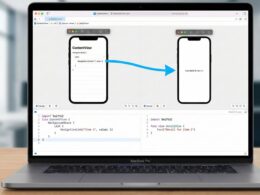
Apple has responded to this challenge by replacing the traditional Simulator with a revolutionary new tool called Device Hub. Seamlessly integrated within the Xcode 27 workflow, the Device Hub is a unified and centralized workspace that allows managing both physical connected devices and simulated devices in a cohesive environment.
The most prominent feature of the Device Hub is dynamic simulator resizing. Imagine you are building a universal application. Instead of having to stop execution, boot up a new iPad simulator, recompile, and wait, the Device Hub allows dragging the edges of the running application window. The system recalculates the interface in real-time, smoothly transitioning from a compact iPhone layout to an iPadOS split view, or adapting to the unique dimensions that the next iPhone Fold will have when unfolded.
Additionally, interactive testing capabilities have greatly improved. The AI agents we discussed earlier can now interact directly with the Device Hub. You can instruct an agent to “navigate to the checkout screen and verify if the Apple Pay button overlaps with the French text,” and the AI will control the simulator, perform the actions, evaluate the visual result, and report the status back to you.
Foundation Models Framework: Democratizing Complex AI
Beyond the improvements to the editor itself, the core of Apple’s strategy to empower developers materializes in the massive expansion of the Foundation Models Framework and the introduction of a new API called Core AI. Apple knows that the next generation of must-have applications will integrate deep artificial intelligence capabilities. Until now, the biggest hurdle for indie developers and small studios has been the prohibitive cost of the cloud infrastructure needed to run large models.
In a bold move that has shaken the industry, Apple announced that it will offer free access to its Apple Foundation Modelsrunning on the Private Cloud Compute infrastructure for all developers who have fewer than two million initial downloads on the App Store. This measure eliminates huge server costs as a barrier to entry in one fell swoop. Now, an indie developer in their bedroom can build world-class AI tools without the fear that a surprise cloud bill will drive them into bankruptcy if their app goes viral overnight.
The framework has also received a monumental technical update: support for image input. Multimodality is the gold standard of modern AI. With this update, developers can create applications that process images and text simultaneously through models run directly on the device (on-device). For example, a nutrition app could allow the user to take a picture of their plate of food, and the on-device model would identify the ingredients, estimate the calories based on additional textual descriptions, and return a structured nutritional table in milliseconds, all without sending the photo to an external server, preserving the sacred privacy that characterizes the company.
- Highlighted Metric: 20 Billion parameters are managed by the new local AFM 3 Core Advanced model.
Third-Party Models and Dynamic Profiles: The Hybrid Approach
Apple has always been known for its closed ecosystem, but with Xcode 27 and the Foundation Models Framework, the company is adopting a surprising pragmatism. They have introduced server-side model execution and integration that allows developers to call third-party models—specifically mentioning Anthropic’s Claude and Google’s Gemini—through exactly the same unified Swift API they use for Apple’s models.
This level of flexibility is unprecedented. A developer can write their artificial intelligence logic just once in Swift. Then, depending on the complexity of the task, the state of the internet connection, or user preferences, the application can dynamically decide whether to route the request to the local model (free, private, lightning-fast), to Apple’s Private Cloud Compute servers, or to an external provider like OpenAI or Google.
To manage this orchestration, Apple introduced Dynamic Profiles, a system designed to build multi-agent workflows. In complex enterprise applications, one “agent” is rarely enough. Dynamic Profiles allow configuring several agents with specific roles (for example, an expert agent in database retrieval, another expert agent in text summarization, and another in email drafting) and having them collaborate with each other within the same application under the structural supervision of Apple’s framework. Furthermore, the company promised that key parts of this routing technology will be released as open source later this summer.
Liquid Glass and the Inevitable Evolution of Design
One of the announcements that generated the most buzz, and some controversy, was the confirmation of the forced migration to the Liquid Glass design language. Gradually introduced in the past, Liquid Glass is characterized by its deep use of real-time translucency, materials that reflect the color of underlying content, and physical animations based on user inertia.
Until now, developers could opt out of using it via flags in their code, keeping flatter, more traditional interfaces. With Xcode 27, Apple has removed the opt-out option. Any application recompiled using Xcode 27 will automatically adopt the new design language. While this will force some studios to revise parts of their custom interfaces, the net result for the ecosystem will be dazzling visual consistency. Users of iOS 27 and macOS Golden Gate will experience a system where every third-party app feels as immersive, tactile, and polished as the system’s own native apps.
Xcode Cloud and Performance in MLX
Apple’s continuous integration and delivery (CI/CD) ecosystem, Xcode Cloud, has not been left behind. Thanks to the massive migration of its server infrastructure to the latest Apple Silicon chips, builds in Xcode Cloud are now up to twice as fast. For large teams, halving the time it takes to compile and test an app means faster iterations and less downtime waiting for servers to greenlight an update.
Additionally, Xcode Cloud now supports the compilation of applications that make intensive use of the Metal 4 graphics API, as well as full support for natively building visionOS applications, greatly facilitating development for the Apple Vision Pro mixed reality headset.
And speaking of Metal, Apple’s open-source machine learning research framework, MLX, received special attention. The new version fully supports Metal 4 hardware optimizations and, what is revolutionary for research labs and universities, can now scale the training of massive artificial intelligence models across multiple networked Mac computers via RDMA (Remote Direct Memory Access) technology using Thunderbolt cables. A team of researchers can now daisy-chain a dozen powerful Mac Studio computers to create a distributed supercomputing training cluster capable of processing trillions of operations per second without the colossal energy costs of traditional data centers.
The Final Impact: App Intents and Spatial Preview
Finally, Apple detailed how these new capabilities integrate with everyday consumer use through App Intents and the redesigned Siri in iOS 27. The new Siri is no longer just a voice interface for searching the internet; it is a master agent capable of manipulating applications. Apple showed how third-party apps, using the Line messaging app as a prominent example, can expose their functionalities to Siri semantically.
Thanks to the App Intents ecosystem enhanced by Foundation Models, a user can tell Siri: “Tell Maria via Line that I’ll be 10 minutes late based on current traffic”. Siri will be able to open the maps app, calculate the delay, interact with the messaging app, draft the message with a natural tone, and send it, all without the developer having to code specific and rigid natural language processing rules.
For mixed reality development, the new Spatial Preview framework promises to dramatically accelerate 3D work. Developers on macOS can now extend their 3D models and spatial simulations in real-time directly into the physical space around a user wearing an Apple Vision Pro. Modifying the code on the Mac screen and seeing how the geometry of the visionOS app changes instantly before the developer’s eyes eliminates countless hours of compiling and installing.
Conclusion: A New Era of Possibilities
The improvements announced at WWDC 2026 mark a historic moment. With Xcode 27, Apple has not just polished a tool; it has changed the very nature of how software is written. Agentic programming will cease to be a curiosity to become an indispensable competitive necessity. Developers who adopt these tools—whether relying on agents to solve complex bugs, using the Device Hub to adapt interfaces to impending foldable devices, or integrating the free multimodal AI of Foundation Models into their projects—will build the next generation of leading applications.
As the technical and economic barrier to implementing cutting-edge artificial intelligence drops dramatically, the true metric of success for Apple developers will no longer be how many hours they can spend writing maintenance code or debugging minor issues, but their creative capacity, their product vision, and how they use these intelligent tools to solve real human problems. Apple has handed over the key to the next technological revolution; it is now in the hands of the developer community to open the door.