


If you are starting to develop apps for Apple platforms, one of the first questions you may have is the difference between Swift and SwiftUI. Although these two technologies are closely related and are frequently mentioned together, they serve completely different purposes.
Understanding the relationship between Swift and SwiftUI is essential for any iOS Developer who wants to build modern applications for iPhone, iPad, Mac, Apple Watch, and Apple TV.
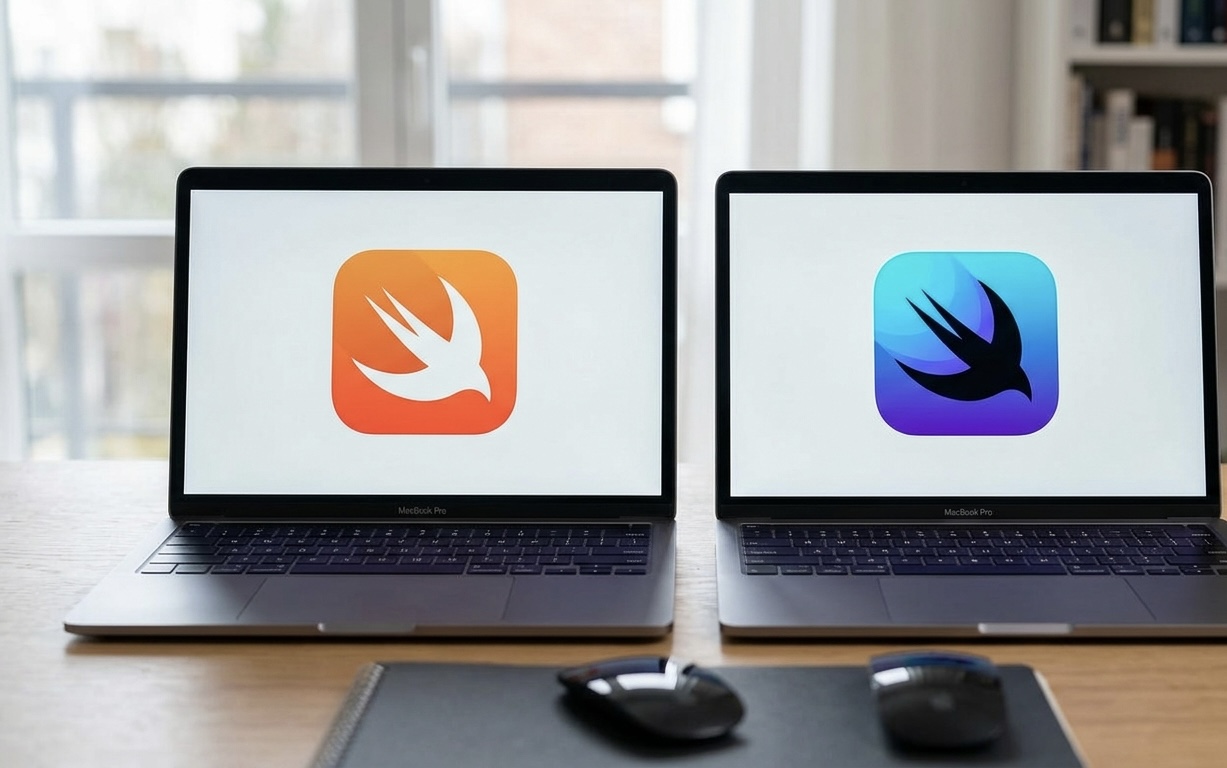
In simple terms, Swift is a programming language, while SwiftUI is a user interface framework built by Apple that uses Swift. They work together, but they are not interchangeable.
What Is Swift?
Swift is Apple’s general-purpose programming language. Apple introduced Swift in 2014 as a modern alternative to Objective-C, with a focus on performance, safety, and developer productivity.
Swift can be used to create many different types of software. Although it is particularly popular for Apple platforms, the language is not limited to creating iOS applications.
With Swift programming, developers can implement application logic, process data, communicate with APIs, work with databases, handle networking, perform calculations, and create the underlying functionality of an application.
Swift includes modern programming concepts such as optionals, protocols, generics, closures, structured concurrency, async and await, and strong type safety.
For an iOS Developer, learning Swift is therefore fundamental. Whether you use SwiftUI, UIKit, or other Apple frameworks, Swift provides the programming language used to implement your application.
What Is SwiftUI?
SwiftUI is Apple’s declarative user interface framework. Apple introduced it in 2019 to provide developers with a modern way of creating interfaces across its platforms.
Unlike Swift, SwiftUI is not a programming language. It is a framework that provides tools, views, controls, layouts, navigation systems, animations, and other components required to build an application’s user interface.
One of the most important characteristics of SwiftUI is its declarative approach. Instead of describing every step required to create and update a user interface, developers describe what the interface should look like for a particular state.
SwiftUI then manages many of the details required to update the interface when that state changes.
This approach can significantly simplify interface development, particularly for applications that need to run across multiple Apple platforms.
Swift vs SwiftUI: The Main Difference
The easiest way to understand the difference between Swift and SwiftUI is to think about their roles.
Swift is the language used to write the application’s logic. SwiftUI is the framework used primarily to construct its user interface.
For example, an application might use Swift to implement networking, data processing, business rules, and application logic. SwiftUI can then be used to display that information through screens, lists, buttons, forms, navigation, and other interface components.
Therefore, comparing Swift and SwiftUI directly is not exactly an apples-to-apples comparison. Swift is a programming language, while SwiftUI is a framework that depends on Swift.
Swift and SwiftUI Comparison
The following table summarizes the main differences:
| Feature | Swift | SwiftUI |
|---|---|---|
| Type | Programming language | User interface framework |
| Created by | Apple | Apple |
| Introduced | 2014 | 2019 |
| Main purpose | Application logic and software development | Building user interfaces |
| Syntax | Swift language syntax | Swift-based declarative syntax |
| Used with | Many Apple and non-Apple projects | Primarily Apple platforms |
| UI development | Not specifically a UI framework | Designed specifically for UI |
| State management | Provides language features | Provides tools for reactive UI state |
| Learning requirement | Fundamental for Swift development | Requires knowledge of Swift |
| Main development tool | Xcode and other Swift-compatible tools | Xcode |
Do You Need to Learn Swift Before SwiftUI?
Yes, learning the fundamentals of Swift programming before going deeply into SwiftUI is highly recommended.
Because SwiftUI is built around Swift, developers need to understand basic Swift concepts such as variables, constants, functions, structures, enumerations, protocols, closures, optionals, and property wrappers.
SwiftUI also makes extensive use of concepts such as state and data flow. Without a solid understanding of Swift, these concepts can be considerably more difficult to understand.
However, you do not need to become an advanced Swift expert before experimenting with SwiftUI. Beginners can learn both technologies progressively.
SwiftUI and Xcode
Xcode is Apple’s integrated development environment for creating applications for Apple platforms. It provides the tools necessary to write Swift code and build applications using frameworks such as SwiftUI.
For an iOS Developer, Xcode is where Swift and SwiftUI come together.
Xcode includes features specifically designed for SwiftUI development, including previews, debugging tools, project management, code completion, and interface development capabilities.
A typical modern iOS project can therefore contain Swift code for application logic and SwiftUI views for the user interface, all developed within Xcode.
Can Swift Be Used Without SwiftUI?
Absolutely. Swift does not require SwiftUI.
Developers can use Swift with other frameworks, including UIKit, Foundation, SwiftData, Core Data, AVFoundation, MapKit, and many other Apple technologies.
For example, an application can use Swift with UIKit to create its user interface instead of SwiftUI. Swift can also be used to develop command-line tools, server-side applications, packages, and other software.
Similarly, SwiftUI is not the only way to create an interface for Apple platforms.
Can SwiftUI Be Used Without Swift?
SwiftUI is designed to be used with Swift. Since SwiftUI’s APIs and declarative syntax are based on Swift, understanding Swift is essential for developing applications with the framework.
This is why learning Swift should normally be the first step for developers who want to specialize in SwiftUI.
Which One Should an iOS Developer Learn?
The answer is both.
If your goal is to become an iOS Developer, learning Swift should be your foundation. Once you understand the language, you can start learning SwiftUI and Apple’s modern approach to interface development.
The difference between Swift and SwiftUI is ultimately straightforward: Swift is the programming language, while SwiftUI is a framework for building user interfaces with that language.
Together, they form an important part of Apple’s modern development ecosystem. By combining Swift programming, SwiftUI, and Xcode, developers can build powerful applications for the iPhone, iPad, Mac, Apple Watch, and other Apple platforms.
Understanding how these technologies complement each other is one of the first steps toward becoming a proficient modern iOS Developer.