

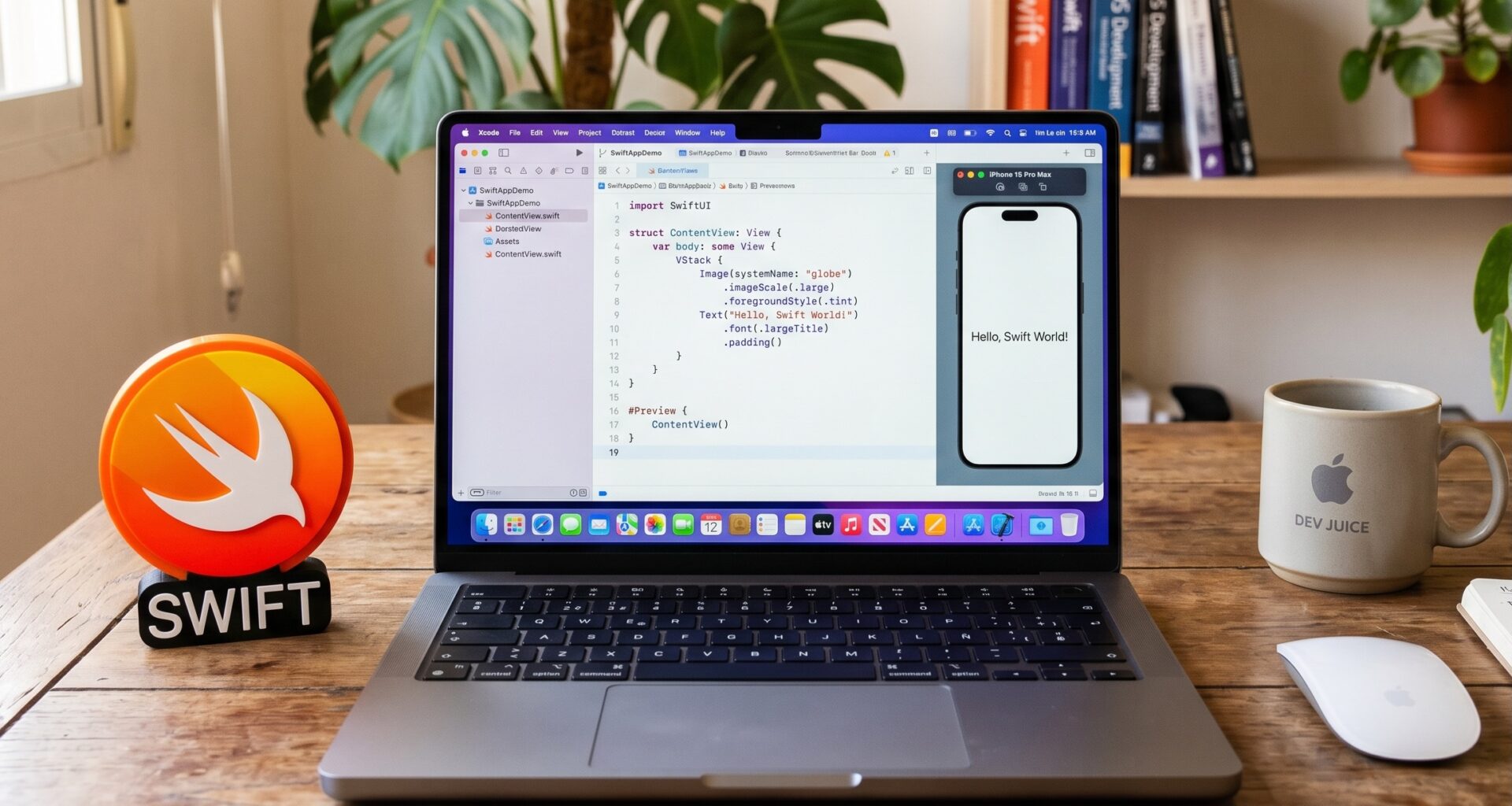

The software development world for the Apple ecosystem has just experienced one of the most astonishing evolutionary leaps in its history. With the recent presentation at WWDC26, the arrival of Agentic Coding in Xcode 27 has completely redefined what it means to be an iOS Developer. We are no longer talking about simple assistants that complete a line of code or suggest closing a conditional block. We are facing an era where Swift programming is elevated to a level of architectural orchestration, where the developer acts as a director and artificial intelligences act as their executing engineers.
Inspired by recent tech publications and the ever-changing ecosystem, in this article, we will conduct an exhaustive analysis of how Xcode 27 alters the traditional workflow, how SwiftUI benefits from this unprecedented integration, and what you must do to stay relevant in this new frontier of Swift and Apple technologies. If your day-to-day revolves around Xcode, get ready, because your integrated development environment (IDE) has just come to life.
1. From Assistance to Autonomy: What is Agentic Coding in Xcode 27?
Over the past few years, we have seen how predictive autocomplete tools and integrated contextual chats tried to speed up coding. However, the concept of Agentic Coding goes several steps further. An autonomous agent within Xcode 27 not only “knows” what code to write based on a prompt, but also possesses the ability to plan, execute, verify, and correct its own work within the full context of your project.
Agentic Coding in Xcode 27 allows artificial intelligence models to interact natively with your project’s file system, build schemes, the debugger, and most impressively, the SwiftUI canvas. When you ask an agent to “redesign the user profile screen to support Dark Mode and improve accessibility,” the Xcode agent doesn’t just spit out code. Instead:
- It analyzes the existing view hierarchy in your source code.
- It identifies the current colors, typography, and SwiftUI modifiers.
- It proposes an action plan and generates the necessary code in Swift.
- It compiles the project in the background and renders a preview to visually verify that the changes are correct.
- It reads the errors or warnings from the Issue Navigator if the build fails, and iteratively corrects its own code until it compiles perfectly.
This “self-healing” and iterative verification capability drastically reduces the time an iOS Developer spends dealing with trivial syntax errors or UI misalignments, allowing them to focus on business logic, performance, and security.
The Paradigm Shift: Instead of writing every line manually, the Swift programming professional now defines specifications, reviews architectures, and evaluates the decisions made by the agents, operating at a much higher level of abstraction.
2. The Invisible Architecture: Model Context Protocol (MCP) in Xcode
The true technical magic that makes Agentic Coding in Xcode 27 possible is the adoption of the Model Context Protocol(MCP). Apple has not locked its ecosystem to a single AI provider. Instead, it has built an infrastructure that allows connecting the most advanced LLMs (Large Language Models) on the market—such as Anthropic’s Claude, OpenAI’s models, and Google’s Gemini—directly into the core of Xcode.
Through the integrated MCP server, Xcode 27 exposes dozens of native tools to these agents. To understand the impact of this on daily Swift programming, let’s look at the categories of tools these agents have access to:
- File System Operations: Agents can navigate your project, read, write, update, move directories, and even run regular expression searches (grep) across thousands of files at once.
- Build & Test: They have the ability to execute
xcodebuild, compile specific schemes, access build logs, and, crucially, run your unit and integration test suites (XCTest or the new Swift Testing framework). - Native Diagnostics: Direct access to the Xcode issue navigator. The agent sees the same red errors and yellow warnings as you do, with all their semantic context.
- Preview Rendering: One of the most revolutionary features for SwiftUI development. The agent can capture and analyze the visual output of a SwiftUI Preview, ensuring that a button doesn’t overlap with another text.
- Semantic Documentation Search: Using local (on-device) embedding models via the new Core AI framework, agents can instantly search Apple’s official documentation and WWDC video transcripts to find the most modern and idiomatic way to use an API in Swift.
For any iOS Developer, this means the IDE is no longer just a text window; it is an active collaborator that understands the rules of the game and has hands on the keyboard.
3. SwiftUI and Autonomous Visual Generation
Since its introduction, SwiftUI changed the way we build interfaces, moving from imperative to declarative interfaces.Now, with Agentic Coding in Xcode 27, UI creation enters the era of “declaration of intent.”
Imagine the following scenario: You have a basic design sketch and need to transform it into code. Instead of manually writing the VStack, HStack, padding modifiers, and color schemes, you open a new “Conversation” in Xcode (by pressing Command-0) and specify:
Prompt: “Create a SwiftUI view for a product detail. It must include a header image with a parallax effect, a prominent title, a dynamic price based on a
Productobject, and an ‘Add to cart’ button that has a bounce animation when pressed. Use the system typography and ensure it supports VoiceOver.”
The agent will get to work immediately. It will write the SwiftUI struct, define the state properties (@State or the modern @Observable macro in Swift), implement the accessibility modifiers, and generate a preview. The most shocking part is not the initial generation—which we already saw in previous versions—but what happens if it makes a mistake.
If the agent applies an outdated modifier, the Xcode 27 diagnostics will notify it. The agent will read the error (“‘padding’ must be applied before ‘background’ for desired effect…”), correct its code, and recompile. The iOS Developer receives refined, tested, and visually verified code. Your role transforms into that of a visual and architectural quality supervisor.
4. Swift Programming: Critical Skills for the New Developer
A common fear in the tech community is that such powerful tools will reduce the need to know the language deeply.Recent studies have shown an interesting paradox: while junior developers can ship code faster with AI assistance, their deep understanding of the codebase (mastery) can decrease if they delegate all problem-solving.
However, for the professional iOS Developer, Agentic Coding in Xcode 27 demands more knowledge of Swift programming, not less. The difference lies in that your knowledge is now applied to critical evaluation instead of pure typing. Essential skills now include:
- Critical Architecture Review: Large language models are excellent at creating isolated components, but they can create chaos if left to design the entire architecture (MVVM, TCA, Clean Architecture) without supervision. The developer must establish robust foundations in Swift.
- Prompt and Context Engineering: Knowing how to use the
@symbol in Xcode 27 to include specific files, symbols, or documentation in the agent’s context is vital. Providing the right context is 80% of the success in Agentic Coding. - Mastery of Advanced Concurrency: With
async/await, actors, and structured tasks, concurrency in Swift remains a complex area. Agents sometimes propose solutions that compile but can cause logical race conditions. The human eye remains indispensable here. - Performance Optimization and Profiling: Instruments remains a human tool. Interpreting memory consumption graphs or CPU cycles and then instructing the agent on how to refactor an inefficient block of code will be one of your main tasks.
5. The Impact of Native Intelligence Frameworks (Core AI and Foundation Models)
Beyond Xcode using artificial intelligence to help you program, Apple has revolutionized the way developers can integrate AI within their own applications. Alongside Xcode 27, the consolidation of the Foundation Models and Core AIframeworks changes the ecosystem landscape.
The iOS Developer of 2026 no longer needs to set up complex backend servers in Python for natural language processing tasks. Using Swift, you can invoke local models (such as Apple Foundation Model 3) or seamlessly connect cloud APIs.The code written by the agents themselves will often suggest using these native frameworks.
For example, adding text summarization capabilities to a notes app no longer requires a third-party dependency. An Xcode 27 agent can implement it instantly using the native framework, optimized for the Apple Neural Engine (ANE) of the M and A series chips, ensuring user privacy by keeping processing on-device.
6. Multi-Agent Collaboration and Extensibility
One of the least discussed but most transformative aspects of this update is the extensibility capability. Xcode 27 is not limited to default agents. Thanks to the Agent Client Protocol, design tools like Figma and platforms like GitHub are already offering frictionless integrations.
In the practice of Swift programming, this means an iOS Developer can instruct their IDE as follows: “Agent, review the latest design linked in Figma for the login screen, compare the differences with our current view in SwiftUI, update the colors and margins according to the new design system, then create a Pull Request on GitHub”.
The agent will coordinate multiple tools: it will fetch the Figma design JSON, modify the SwiftUI code, use Xcode‘s internal tool to validate that it compiles, run the UI tests, and use the git CLI to commit and push the changes.
7. Challenges, Security, and Ethical Considerations
Despite all its power, Agentic Coding in Xcode 27 is not without its challenges. The main one is “dependency hallucination” or the use of obsolete Swift APIs, although semantic search in the documentation mitigates this considerably.
Another point of debate is code security. Apple has implemented strict safeguards: the agent requires explicit permissions to run scripts on your machine, and a series of confirmation dialogs ensure that hidden processes do not compromise your development environment. For strict enterprise projects, teams can configure Xcode to exclusively use local models or Private Cloud Compute, ensuring that proprietary source code is never used to train public models.
8. Preparing for the New Era of iOS Development
For those who fear this technology will replace their jobs, the history of computing teaches a different lesson: higher-level tools do not eliminate engineers, they simply raise the bar on what an engineer can build in a day. An iOS Developerarmed with Agentic Coding in Xcode 27 can now prototype, develop, and launch an application with a quality and sophistication that five years ago would have required a full team of specialists.
To fully take advantage of this revolution, we recommend the following practical steps:
- Update your Architecture Paradigms: Deeply understand design patterns in Swift. Your codebase must be modular so agents can work in bounded areas without breaking the rest of the application.
- Master SwiftUI and its Macros: The more declarative your code is, the better generative models will understand and manipulate it.
- Adopt a Test-Driven Development (TDD) Workflow: Xcode 27 agents shine when they have tests to pass. Write solid tests, and the agent will have a clear North Star to direct its autonomous coding efforts.
- Experiment with Different Models: Don’t just stick with Apple’s default model. Use the connector to test how models like Claude excel at complex refactoring, while others might be faster at base UI generation.
9. Conclusion: Code as a Conversation
The launch of Xcode 27 marks the dividing line between classic app development and next-generation assisted development. Agentic Coding in Xcode 27 transforms the IDE into a dynamic partner. The language syntax, while still critical, takes a backseat to problem-solving, user experience design, and complex systems logic.
For the iOS Developer, Swift programming has become a conversation. We talk to the system, instruct agents, verify with SwiftUI, and orchestrate a symphony of tools working tirelessly at our disposal. The future of app development isn’t about writing more code; it’s about writing better software, faster, and with more creativity than ever.