



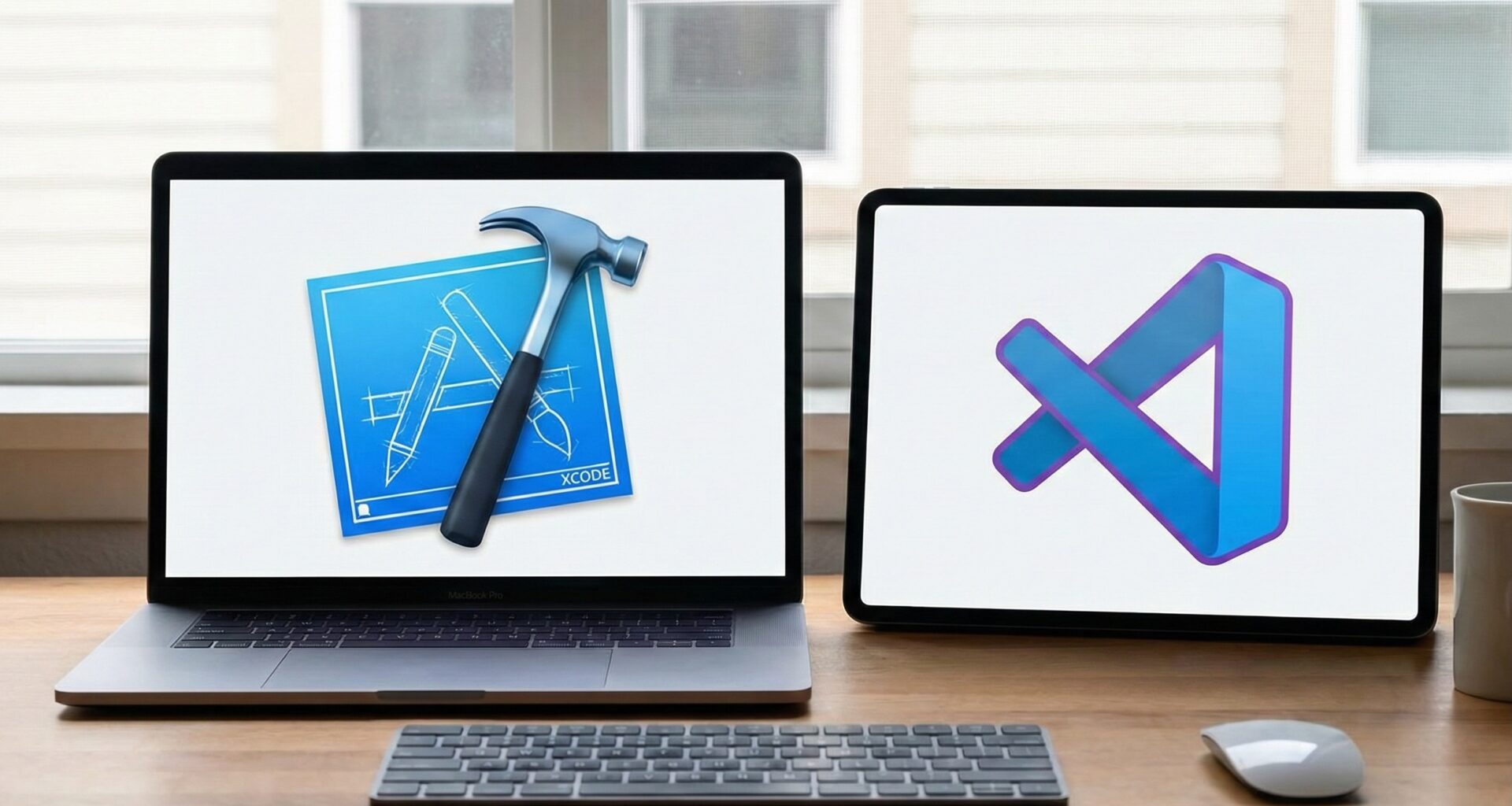

If you are an iOS developer today (or aspire to be one), you likely face a daily crossroads. For over a decade, the answer to “What tool should I use to code?” was unequivocal: Xcode. It was Apple’s walled garden, the only gateway.
However, times have changed. Swift is now a robust cross-platform language, and SwiftUI has decoupled the interface from the old Interface Builder. In this scenario, a heavyweight challenger has emerged: Visual Studio Code (VS Code).
In this deep-dive tutorial, we will break down what each tool is, their architectural differences, their surprising similarities, and most importantly, how you can combine both to boost your Swift and SwiftUI workflow.
Part 1: What is Xcode? The Monolithic Giant
To understand the comparison, we must first define the contenders.
Xcode is an IDE (Integrated Development Environment). It is not just a text editor; it is a complete suite of tools. When you download Xcode, you are downloading:
- The Code Editor: Where you write Swift.
- The Compiler: The LLVM and Clang toolchain.
- Interface Builder / Canvas: The visual renderer for SwiftUI and UIKit.
- Debugging Instruments: Memory, CPU, and graphics analysis tools (Instruments).
- Simulators: Virtual replicas of iPhone, iPad, Apple Watch, and Vision Pro.
The Xcode Philosophy
Xcode is designed by Apple for the Apple ecosystem. Its integration is vertical. It knows the insides of your Mac and is optimized to manage complex files like .xcodeproj or .xcworkspace. For an iOS developer, Xcode is “Headquarters.” It is where you sign the app, manage certificates, and hit the “Publish to App Store” button.
Part 2: What is Visual Studio Code? The Swiss Army Knife
Visual Studio Code (commonly called VS Code) is not an IDE in the strict sense; it is a lightweight source code editor developed by Microsoft.
Its philosophy is diametrically opposed to Xcode’s. VS Code starts “empty.” By default, it is just a glorified notepad with syntax highlighting. Its power lies in Extensions.
- Want to code in Swift? Install the official extension from the Swift Server Workgroup.
- Want to manage Git? Install GitLens.
- Need AI? Install Copilot or use a fork like Cursor.
For the iOS developer, VS Code represents speed, customization, and freedom. It doesn’t force you to use a specific project structure and is incredibly fast at opening files.
Part 3: Critical Differences (The Technical Comparison)
Here is where the real debate lies. Let’s analyze point by point how they behave regarding Swift and SwiftUI.
1. The Build System
- Xcode: Owns the build system. It manages dependencies, “Run Phase” scripts, code signing, and library linking. If you work with a standard iOS project (
.xcodeproj), Xcode is almost mandatory to configure “Targets.” - Visual Studio Code: Does not know how to natively compile an iOS app by itself. It relies on the terminal and tools like
xcodebuildor Swift Package Manager (SPM).- The Catch: If your project is based entirely on SPM packages, VS Code shines. But if you need to configure Capabilities (like Push Notifications or iCloud), you will have to open Xcode.
2. The SwiftUI Experience (Canvas vs. Code)
This is the deciding point for many.
- Xcode: Possesses the SwiftUI Canvas. This tool renders your view in real-time while you write code. You can see color, size, and layout changes instantly, and even interact with the app (Live Preview) without compiling the entire project.
- Visual Studio Code: Does not have a native Canvas. You see only code. Although there are tricks and plugins to try to replicate it, the experience of visually designing UI in VS Code is practically null. If you are a very visual (“Pixel Perfect”) developer, you will miss Xcode.
3. Text Editing and Refactoring
Here is where Visual Studio Code humbles Xcode.
- VS Code: Is, first and foremost, a text editor. Its capabilities for multicursor (editing 10 lines at once), Regex search and replace, and file navigation are instant and fluid. Moving through a giant project in VS Code feels lightweight.
- Xcode: Historically, it has been slow with indexing. Although it has improved, refactoring (e.g., renaming a variable across the entire project) sometimes fails or takes too long. The editor feels “heavy.”
4. Artificial Intelligence and Autocomplete
- VS Code: Was a pioneer with GitHub Copilot. AI integration in VS Code is mature. You can chat with your code, ask it to write unit tests for your Swift function, and latency is minimal.
- Xcode: Apple has integrated predictive code completion. Its advantage is that it knows the Apple SDK better than anyone (it hallucinates less with non-existent APIs), but the chat and “Agent” experience is often superior in the VS Code environment (or derivative editors).
Part 4: The Similarities (SourceKit-LSP)
You might be surprised to know that, under the hood, both use the same “brain” to understand Swift.
Apple developed something called SourceKit-LSP (Language Server Protocol).
- When you type
View.in Xcode and it suggestspadding(), that is SourceKit working. - When you type
View.in VS Code (with the Swift extension installed), it is the same SourceKit working.
This means that the quality of errors, warnings, and “Go to Definition” is technically identical in both, as both query the same language server. The difference is how the interface shows you that information.
Part 5: Tutorial – How to Configure VS Code for iOS Development
If you want to try life outside of Xcode, follow these steps to set up a robust Swift development environment in VS Code.
Step 1: Tool Installation
You need to have Xcode installed (yes, it is ironic, but VS Code needs the compilers that come inside Xcode).
- Install Xcode from the Mac App Store.
- Open the terminal and run:
xcode-select --installto ensure the command line tools are active.
Step 2: Essential Extensions
Open Visual Studio Code and install the following extensions from the Marketplace:
- Swift (by The Swift Server Workgroup): This is the official one. It provides syntax highlighting, debugging, and LSP support.
- CodeLLDB: Essential for setting “breakpoints” and debugging your Swift code.
- SwiftUI Snippets: A useful collection for writing SwiftUI structures fast.
- Apple Swift Format: So your code automatically aligns with official style guides.
Step 3: Working with Swift Package Manager
VS Code works best if your project is structured as a package.
- Create a new folder.
- In the terminal inside that folder:
swift package init --type executable(or library). - Open that folder with VS Code.
- You will see that VS Code automatically detects the
Package.swiftfile and will ask if you want to download dependencies. Say yes.
Step 4: Build and Run
With the Swift extension, you will see a “Play” icon in the bottom bar or over your main function. When pressed, VS Code will use the local Swift compiler to build and execute your logic.
Pro Note: To run a full iOS app on the simulator from VS Code, you will need third-party tools like Xcodes, Fastlane scripts, or invoking
xcodebuildfrom the integrated terminal in VS Code.
Part 6: The Hybrid Workflow (The Winning Strategy)
As a senior iOS developer, you shouldn’t choose a side. You should use both. Here is a recommended personal workflow:
When to use Xcode:
- UI Design: When creating views in SwiftUI, I need the Canvas. Seeing changes instantly is priceless.
- Deep Debugging: If I have a “memory leak” or a performance issue, Xcode’s Instruments have no rival.
- Project Configuration: Adding Capabilities, changing app icons, configuring provisioning profiles.
When to use Visual Studio Code:
- Business Logic: When writing ViewModels, network services, or pure data logic that has no UI. I do it in VS Code because I can fly while writing text.
- Git Management: The merge conflict resolution interface in VS Code is infinitely superior to Xcode’s.
- Scripts and Backend: If my iOS app uses a Swift backend (Vapor) or Python/Ruby scripts for automation, I edit those files in VS Code.
- Code Review: Reading colleagues’ code is more comfortable and legible in VS Code.
Conclusion: Which One to Choose Today?
The short answer for the novice iOS developer: Start with Xcode. It is the official tool, documentation assumes you use Xcode, and it is the only way to see your SwiftUI designs live without friction. You cannot publish an app without it.
The answer for the professional: Master Xcode, but install Visual Studio Code.
Modern development in Swift is breaking the barriers of the Apple ecosystem. With the arrival of Swift on Windows and Linux, and server-side development, VS Code is becoming the standard for “Swift outside the iPhone.”
However, to create the next great App Store app, symbiosis is key. Use the surgical precision of Xcode to assemble your UI and compile, and use the speed and flexibility of VS Code to write the logic that makes your app work.
Mastering both tools is not a redundancy; it is a superpower.
Summary Table: Xcode vs VS Code
| Feature | Xcode | Visual Studio Code |
| Creator | Apple | Microsoft |
| Type | Full IDE | Code Editor + Extensions |
| SwiftUI Canvas | Native (Excellent) | Not native (Requires plugins) |
| Text Editing | Good, but heavy | Excellent, fast, and versatile |
| Build System | .xcodeproj / .xcworkspace | Folder-based / SPM |
| Debugging | Visual, powerful (Instruments) | Textual LLDB (Good) |
| AI Copilot | Swift Assist (Native) | GitHub Copilot / Cursor (Superior) |
| Cost | Free (Mac Only) | Free (Cross-platform) |
If you have any questions about this article, please contact me and I will be happy to help you 🙂. You can contact me on my X profile or on my Instagram profile.