



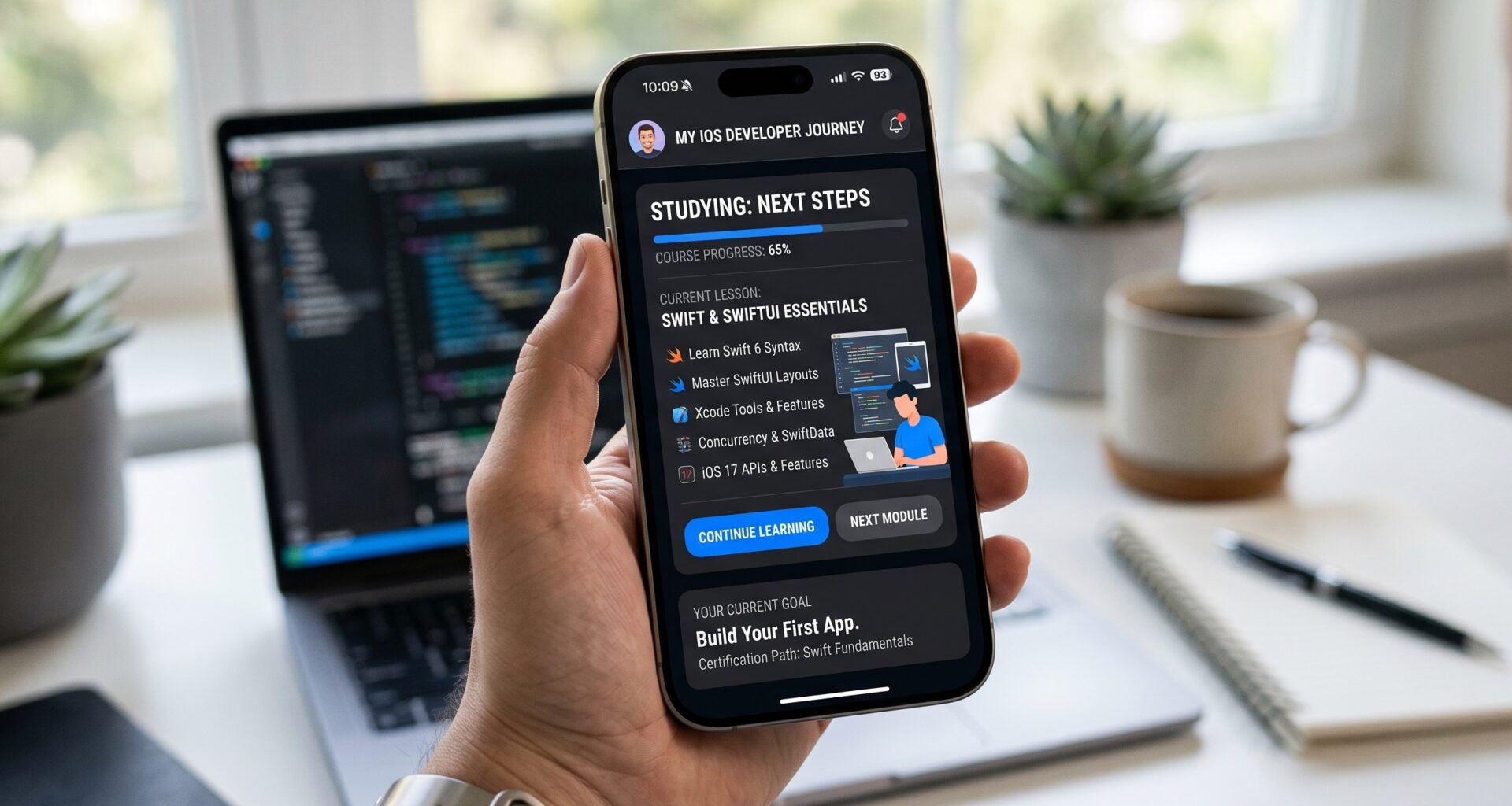

Facing a technical interview as an iOS Developer can be a monumental challenge, especially when the Apple ecosystem evolves at a breakneck pace. The transition from UIKit to the declarative paradigm has changed the rules of the game. Today, interview questions for a Senior iOS Developer in SwiftUI are not limited to knowing how to center text; they evaluate your deep understanding of Swift programming, memory management, concurrency, and code scalability.
As a senior developer, you are expected to master SwiftUI not only on the iPhone but also to be able to extrapolate that knowledge to build universal applications across iOS, macOS, and watchOS using Xcode.
In this article, we have compiled and answered 100 key questions ranging from the inner workings of Swift to advanced architectural patterns. Use them as a checklist to validate your knowledge and shine in your next technical interview.
I. Fundamentals of Swift Programming
1. What is the technical difference between some View and any View in Swift? some View is an opaque type resolved at compile time (Static Dispatch), allowing for optimizations. any View is an existential type resolved at runtime (Dynamic Dispatch), which implies a performance impact.
2. How does Static Dispatch work internally versus Dynamic Dispatch? Static Dispatch allows the compiler to know exactly which block of code to execute, optimizing it (e.g., inlining). Dynamic Dispatch uses the Witness Table (or Virtual Table in classes) to resolve the method at runtime.
3. What is a Property Wrapper and how is it implemented? It is a structure that encapsulates the read and write logic of a property. It is implemented using the @propertyWrapper attribute and requires defining a wrappedValue property.
4. How do you prevent Retain Cycles in closures within SwiftUI? By using capture lists ([weak self] or [unowned self]) when the closure retains a class (like a ViewModel) that in turn retains the closure.
5. What is the difference between @escaping and @nonescaping closures? A @nonescaping closure (default) is executed and destroyed before the function returns. An @escaping closure outlives the function, being stored in memory to be executed later (common in asynchronous calls).
6. Explain what the Result Builder is in Swift. It is a syntactic feature that allows building structured values step by step, such as lists or trees. It is the magic behind ViewBuilder in SwiftUI.
7. What are the differences between Opaque Types and Generics? Generics allow the caller to decide the type (func make<T>() -> T), while opaque types allow the function to decide the type, hiding the details from the caller (func make() -> some View).
8. How does Swift handle Type Erasure? It is achieved by wrapping a protocol with Self or associatedtype in a generic class/struct (e.g., AnyView, AnyPublisher), or by using the any keyword in Swift 5.6+.
9. What is the @dynamicMemberLookup directive? It allows a type to provide access to properties using dot-notation syntax at runtime, widely used in SwiftUI Bindings.
10. What is the difference between a Sequence and a Collection in Swift? A Sequence can be iterated (possibly only once and destructively), while a Collection is a sequence that guarantees non-destructive access and direct access to elements via indices.
11. When would you use unowned instead of weak? You use unowned when you are absolutely certain that the reference will not be nil when accessed, avoiding optional unwrapping.
12. Explain the concept of Copy-on-Write (CoW). It is an optimization in value types (like Array or String in Swift) where data is only copied in memory if it undergoes a mutation.
13. What is the Hashable protocol and why is it crucial in SwiftUI? It allows a type to produce an integer value (hash). It is vital in SwiftUI for iterating collections with ForEach or using components like NavigationPath.
14. How do Associated Types work in protocols? They act as placeholders for types that will be defined when a concrete type adopts the protocol, allowing for the creation of generic protocols.
15. What does it mean for Swift to be a Protocol-Oriented language? It means it favors composition through protocols and protocol extensions rather than relying exclusively on class inheritance (OOP).
II. State Management and Lifecycle in SwiftUI
16. When should you use @StateObject versus @ObservedObject? @StateObject is used to instantiate and own the lifecycle of the object. @ObservedObject is used when the view receives an object whose lifecycle is managed by a parent.
17. Explain how @EnvironmentObject injects dependencies. It allows injecting an ObservableObject into the global environment of the view hierarchy, making it accessible to any descendant view without passing it explicitly.
18. What problem does @Binding solve? It allows a child view to read and write a value owned by a parent view, maintaining a Single Source of Truth.
19. Why is it an anti-pattern to initialize an @ObservedObject directly in a view? Because views in SwiftUI are ephemeral and constantly recreated. Upon recreation, the @ObservedObject will lose its previous state and re-initialize, causing data bugs.
20. What is the difference between onAppear and task? onAppear executes synchronous code when the view appears. task creates an asynchronous context and its lifecycle is tied to the view’s (it cancels automatically if the view disappears).
21. What is PreferenceKey used for in SwiftUI? To pass data upwards in the view hierarchy (from child to parent), solving the standard unidirectional flow that goes from parent to child.
22. Explain the @Observable macro introduced in iOS 17. It replaces ObservableObject, eliminating the need for @Published. It optimizes view rendering by automatically tracking which specific properties are read in a view.
23. How would you force the explicit redraw of a specific view? By changing the value associated with the .id()modifier. This tells SwiftUI to destroy the old view and create a completely new one.
24. What is the Environment (not EnvironmentObject)? It is a repository of predefined system values (like color scheme, font size, time zone) accessible via the @Environment wrapper.
25. How do you implement local persistent state in SwiftUI? Using @AppStorage to save lightweight data in UserDefaults, or @SceneStorage to maintain the state of a specific screen/tab while the app is alive.
26. What happens if you update a @State from a background thread? In older versions, it caused a crash. In modern SwiftUI with Swift 5.5+, it is often redirected, but the correct practice is to always update the UI from the MainActor.
27. How do two sibling views communicate in SwiftUI? By Lifting State to a common parent and passing it to both as a @Binding, or by using an ObservableObject injected into the parent.
28. What is @FocusState and on which platforms does it shine? It allows programming and reading which UI element has keyboard focus. It is critical on iOS, macOS (keyboard navigation), and tvOS.
29. When would you use @FetchRequest or @Query? To integrate local databases directly into the view. @FetchRequestfor CoreData and @Query for SwiftData (introduced in iOS 17).
30. What does objectWillChange.send() do? It is a method of ObservableObject that emits a notice to the framework that the object’s properties are going to change, forcing a redraw. It is usually executed automatically with @Published.
III. Layout, Rendering, and Animations in SwiftUI
31. Why is GeometryReader said to break declarative layout? Because it takes up all available space and forces its child views to rely on absolute coordinates, making the code rigid and prone to resizing errors.
32. How does the new Layout protocol work (iOS 16+)? It allows creating custom containers (like custom HStack or VStack) by defining precise measurement and positioning rules without using GeometryReader.
33. What is the size negotiation process in SwiftUI?
- The parent offers a size. 2. The child determines its own size. 3. The child returns its size to the parent. 4. The parent aligns the child in its space.
34. Explain the difference between .frame(width:height:) and .frame(maxWidth:maxHeight:). The first forces a strict, unchanging size. The second defines elastic boundaries, allowing the view to dynamically adapt to the available space.
35. What is matchedGeometryEffect? A modifier that synchronizes the animations of two different views, simulating that they are the same element moving or transforming across the screen.
36. How do you prevent AnyView from impacting performance? By avoiding it entirely. You should use @ViewBuilderinstead or group conditional views inside a Group so as not to destroy the static identity of the hierarchy.
37. What is the .equatable() modifier for? It allows avoiding unnecessary redraws in complex views by comparing if the new data is equal to the old data (requires the view to conform to Equatable).
38. What is the difference between withAnimation and an implicit animation (.animation(...))? withAnimation (explicit) animates all state changes within its closure. .animation (implicit) attaches to a specific value and triggers only when that value changes.
39. What is the Canvas in SwiftUI? A high-performance 2D rendering environment. It is ideal for drawing particles, complex graphs, or simple games where drawing millions of views would affect performance.
40. How do you handle Safe Areas? SwiftUI respects them by default. To ignore them (e.g., for a full background), use the .ignoresSafeArea() modifier.
41. What is Layout Priority? A modifier (.layoutPriority()) that tells the parent which child view should have priority to claim space when the total space is insufficient.
42. Explain what a custom ViewModifier is. It is a structure that adopts the ViewModifier protocol to encapsulate multiple styling and behavioral modifiers, allowing for clean code reuse.
43. How does routing work with NavigationStack? Unlike the old NavigationView, NavigationStack handles data-driven navigation, allowing you to pass an array to path: and push views programmatically.
44. What is a Grid in SwiftUI (iOS 16+)? A container that aligns its children two-dimensionally in structured rows and columns, superior to nesting multiple HStacks and VStacks.
45. How do you style text with dynamic parts in SwiftUI? Using AttributedString interpolation or concatenating Textelements using the + operator.
IV. Architecture and Design Patterns
46. Is MVVM the definitive pattern for SwiftUI? Not necessarily. Although popular, SwiftUI’s architecture already acts as a native Data Binding system. At a senior level, architectures like TCA (The Composable Architecture) or Redux gain a lot of traction.
47. Describe the principles of The Composable Architecture (TCA). It relies on State, Actions, Reducers, and Environments (Dependencies). It is unidirectional, predictable, highly testable, and perfect for complex applications in Swift programming.
48. How do you implement Dependency Injection in SwiftUI? Through the initializer (constructor injection), using Environment, or applying dependency containers with custom Property Wrappers.
49. Why would you avoid Singletons in modern iOS development? They make code rigid, hide a class’s dependencies, hinder unit testing, and can cause concurrency issues.
50. What is the Coordinator or Router pattern in SwiftUI? A pattern pulled from UIKit to take navigation logic out of the View, using objects that manage routes (NavigationPath) injected as an @EnvironmentObject.
51. Explain the SOLID principle: Dependency Inversion (DIP). High-level modules should not depend on low-level modules; both should depend on abstractions (Protocols in Swift).
52. How do you decouple a SwiftUI view from its business model? By creating protocols for the ViewModel (using generics or existential types if using iOS 16+) so the view only knows the data interface, facilitating mocking.
53. What is State-Driven Routing? It is SwiftUI’s approach where navigation is not executed imperatively (e.g., pushViewController), but rather the UI reacts to changes in state variables (isPresented, path).
54. When would you use the Factory pattern in a SwiftUI app? To encapsulate complex view creation logic. For example, a ViewFactory that returns different views based on user type or configuration.
55. Explain the differences between Clean Architecture and VIPER. Both seek separation of concerns. VIPER is highly granular (View, Interactor, Presenter, Entity, Router), while Clean Architecture focuses on circular layers (Domain in the center, Data/UI on the outside).
V. Concurrency, Async/Await, and Combine
56. What problem does async/await solve compared to callbacks? It eliminates Callback Hell (pyramid of doom), makes code linear and manageable, and prevents errors where you forget to call the completion block.
57. What is an Actor in Swift? It is a reference type that isolates its state by mutating data serially, protecting against Data Races in concurrent environments.
58. Explain the @MainActor attribute. It ensures that all marked properties or functions are executed exclusively on the main thread, which is critical for UI updates in SwiftUI.
59. What is the difference between Task and Task.detached? Task inherits the execution context (like the @MainActor or local variables) from the code where it is created. Task.detached does not inherit any context, operating independently.
60. How do you cancel an asynchronous task in SwiftUI? By keeping a reference to the Task object and calling .cancel(), or automatically when the view disappears if the task was created using the .task modifier.
61. What is the Sendable protocol? It defines safe types to pass across concurrent boundaries (between Actors). Value types and Actors are implicitly Sendable.
62. How do you integrate delegate-based APIs with async/await? Using withCheckedContinuation or withCheckedThrowingContinuation to pause the asynchronous function and resume it when the delegate responds.
63. Will Async/Await replace Combine? Not entirely. Async/Await is excellent for one-shot operations (network requests). Combine is superior for processing continuous streams of reactive events over time (like a user typing in a TextField).
64. What is an AsyncStream? It is the native way in Swift concurrency to return multiple values over time (partially replacing Combine’s Publishers).
65. What does a TaskGroup do? It allows executing a dynamic number of concurrent asynchronous tasks in a structured way, waiting for all of them to finish or aggregating their results.
66. Explain CurrentValueSubject vs. PassthroughSubject in Combine. CurrentValueSubject holds an initial state and remembers the last emitted value. PassthroughSubject only emits events without storing state.
67. How do you avoid memory leaks in Combine? By storing the subscription (AnyCancellable) in a Set of cancellables. If the enclosing object is deallocated, subscriptions are automatically canceled.
68. What is Data Race Safety in Swift 6? It is strict compiler validation that mathematically guarantees at compile time that your code will not have memory race conditions.
69. How do you delay a task in milliseconds using modern concurrency? Using try await Task.sleep(nanoseconds: 1_000_000) or in newer versions Task.sleep(for: .milliseconds(1)).
70. What is a Global Actor? An actor that provides isolation to variables or functions scattered throughout the app, with @MainActor being the most famous example built into Xcode.
VI. Multi-platform: iOS, macOS, and watchOS
71. As an iOS Developer, how do you manage macOS-exclusive code in a universal app? Using processor compilation directives, like #if os(macOS), to compile or omit specific code blocks by platform.
72. What is MenuBarExtra and where is it used? It is a SwiftUI structure that allows creating utilities that live in the top menu bar, exclusively for macOS.
73. Explain the use of WindowGroup versus DocumentGroup. WindowGroup creates a standard window hierarchy for the app. DocumentGroup is designed for cross-platform applications focused on file creation and editing (like Pages).
74. How do you handle Digital Crown input in watchOS? Using the .focusable() modifier along with .digitalCrownRotation() to read input values from the watch crown.
75. What navigation paradigm do you prefer on iPadOS/macOS compared to iOS? On large screens, 2 or 3-column navigation (NavigationSplitView) should be favored, whereas on iOS and watchOS the standard is the navigation stack (NavigationStack).
76. How do you optimize battery consumption in a watchOS app using SwiftUI? By using TimelineView for scheduled screen updates or integrating WidgetKit to show complications without running the main app.
77. What is the Hover Effect and where is it relevant? It is a modifier (.hoverEffect()) critical for iPadOS (using the Magic Keyboard) and VisionOS, indicating interactivity when the pointer hovers over a view.
78. How do you handle cross-platform keyboard shortcuts? By adding the .keyboardShortcut() modifier to buttons. They work natively when connecting physical keyboards to iOS devices or directly on the Mac.
79. Explain the importance of ViewThatFits. Introduced in iOS 16, it allows defining multiple views; SwiftUI will evaluate and render the first view that fits without truncating on the screen (very useful from iPhone to watchOS).
80. How do you manage cross-platform interactive notifications? By implementing a UNNotificationContentExtensionwhere the notification UI can be built using SwiftUI across all Apple operating systems.
81. How do you adapt Menu Bar commands in macOS and iPadOS? By modifying the main content in App using the .commands { ... } method to add actions to the top system bar.
82. What is Mac Catalyst vs. a native SwiftUI app for macOS? Catalyst wraps UIKit code to run on Mac. Modern native SwiftUI compiles using AppKit underneath, offering better performance and a native look-and-feel on macOS.
83. What challenges does the virtual keyboard present in watchOS? There is no full keyboard; you rely on quick replies, voice dictation, or Scribble. Text inputs must be constrained with .textContentType().
84. How are graphic resources shared across platforms in Xcode? Using the Assets catalog (.xcassets), marking resources as universal or assigning specific versions per device or platform.
85. Explain the use of Size Classes and TraitCollection in SwiftUI. Though abstracted by @Environment(\.horizontalSizeClass), they allow detecting if the app is in a compact environment (portrait iPhone) or regular (iPad, macOS) to alter the layout.
VII. Xcode, Tools, Testing, and CI/CD
86. Why do SwiftUI Previews sometimes crash and how do you fix it? They often crash due to missing dependency injection, like not providing an .environmentObject() in the preview, or due to compile-time errors. Using static Mock data is vital.
87. What tool in Instruments would you use to detect unnecessary redraws? The “SwiftUI” template in Instruments. It allows you to inspect the View Body Executions count to identify performance bottlenecks.
88. How do you implement Unit Tests on SwiftUI views? You should not test views directly. Good Swift programming dictates extracting business logic to a testable ViewModel or using frameworks like ViewInspector.
89. What is accessibilityIdentifier used for in UI Tests? To assign a unique string identifier to SwiftUI elements, allowing XCTest to find components regardless of the language or text displayed.
90. How do you manage dependencies in large projects? Using SPM (Swift Package Manager). It is native to Xcode, fast, and allows modularizing the project by separating features into independent local packages.
91. Explain what Xcode Cloud is. It is Apple’s continuous integration and delivery (CI/CD) solution, built directly into Xcode, to automatically build, test, and distribute apps on TestFlight.
92. What is SwiftLint and why use it? A third-party tool that enforces style guides and conventions in Swift code, keeping the codebase consistent in large teams.
93. How do you profile Memory Leaks in Xcode? Using the integrated Memory Graph Debugger in Xcode or the “Leaks” tool in Instruments to locate strong circular references.
94. What is #Preview for compared to the old PreviewProvider? Introduced in Xcode 15, #Preview is a Swift macro that reduces the boilerplate code needed to generate previews, making it much more concise.
95. How do you mock network requests for Unit Testing? Using URLProtocol or creating a protocol for the network client, injecting a MockClient into the tests that returns local data instead of making internet calls.
96. What is Code Coverage and how do you enable it? It measures the percentage of code lines executed during your tests. It is enabled in the Xcode Scheme settings, under the Test tab.
97. Explain how you modularize a monolithic app in Xcode. By creating multiple framework Targets or packaging feature modules (e.g., “Login”, “CoreNetwork”) via Local Swift Packages.
98. What is the Sanitizer in Xcode and which ones do you know? They are tools to catch runtime errors. Notable ones are the Thread Sanitizer (detects data races) and Address Sanitizer (detects memory issues).
99. How do you ensure Dynamic Type works correctly? By using .font(.headline) instead of .font(.system(size: 16)), allowing the system to scale the text automatically based on the user’s accessibility preferences.
100. As a Senior, what do you do if Xcode behaves erratically (e.g., won’t compile without logical errors)? I clean the Build Folder (Cmd + Shift + K), delete the Derived Data folder, restart Xcode, or ultimately, restart the Mac (the infallible triad of the Apple developer).
Conclusion
The role of the iOS Developer has evolved drastically. Passing an interview for Senior iOS Developer in SwiftUIrequires much more than memorizing concepts; it demands understanding the why behind the language’s design decisions and mastering the cross-platform tools that Xcode offers. Whether managing concurrency with async/await, architecting scalable code with TCA, or adapting views for iOS, macOS, and watchOS, modern Swift programming is a rich and challenging ecosystem.